Friday, July 1, 2011

Uruguay: Piriapolis & Punta Del Este

Farming and investing was just part of our objectives for our recent trip to Uruguay. Evaluating Uy as an expat refuge was high among our priorities as well. As with farming, we found much to appreciate in Piriapolis and Montevideo.

Our first days in Uruguay were as guests of David James and Alex Garcia of Sugar Loaf Ocean Club & Spa. We ate and drank, ate and drank some more, and got a feel for the UY beach destinations of Punta Del Este and Piriapolis.

Punta reminded us of Southeast Florida, with high rise condos and upscale shopping on every inch of its peninsula. Piriapolis was more low key, with a pretty half moon bay. Just a couple of miles up from the beach and you are among serene cattle pastures.

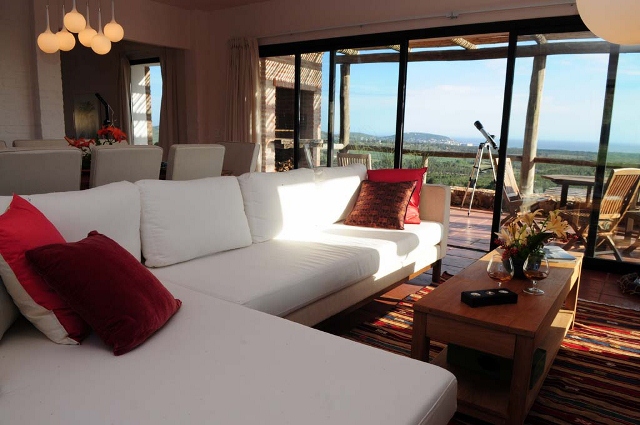
Doug fell in love with this uninterrupted panoramic view of Piriapolis and the ocean. This property sits towards the top of Sugar Loaf mountain, one of the highest elevations in UY.

Should we ever decide to build, our patio will look very much like this. One of us is going to have to learn to cook with fire.

This kitchen shows we aren't exactly going to be suffering down in South America.

A morning ride on the mountain to remind us of the Hill Country...at about a third of the cost.

Uruguayans use their beaches about 2 months of the year, Jan and Feb. There is a bit of use for the shoulder seasons but you will find the condos, the beach houses, the shops and the restaurants mostly closed unless the summer sun is shining.

There is an organized expat community in Punta and Piriapolis. They are distinct and different crowds, to say the least. The meal we had at the expat meeting in Piriapolis was the worst of the entire trip. Yet, we had a fabulous time at a party held in the home of the owners' of Punta's Mexican restaurant.

After our days in Punta and Piriapolis, we felt as if we had a firm handle on what UY beach communities had to offer. Next up comes our sampling of South American city life in Montevideo.

Wednesday, June 8, 2011

Uruguay Farming and Investing

"Uruguay is a good place to be in the farming business."

writes PathFinder International Executive Director, Ronan McMahon, in this article that just posted to my Facebook feed, "A Good Business To Be In."


After our 3 week scouting trip in Uruguay, we have to agree.


"Tucked between the farming giants of Argentina and Brazil is little Uruguay."

One Uruguayan referred to her country as a "big farm." After leaving the city limits of Montevideo, it is evident why. Once you leave the populated areas of Montevideo, Colonia and Punta Del Este, all you see is "agri rich" farmlands. We visited the departments of San Jose, Colonia, Soriano, Florida, Durazno and Rocha in search of farms suitable for our farm operations and land appreciation syndication. In truth, we saw all but 3 of UY's departments and they would be unsuitable for farming.

"Uruguay has good land." I would add "and the most advanced farming methods in the world."

A hedge fund manager, reviewing our investment, asked why we would farm in UY.

The Ogallala aquifer, which yields 30% of all US ground water is drying up. The entire of Uruguay sits on the Guarani aquifer and it is untapped. Adequate rainfall provides for the crops of UY while the US is irrigation reliant. Arable lands in the US are being lost to urban sprawl while only 1M hectares of 3M are currently cultivated for agriculture in UY. Uruguay's agriculture industry is less than a decade old and adopted the zero tillage, mechanization and logistical infrastructure of the Argentines. Conventional US farming has diminishing productivity with irreparable damage to the soil. Uruguay's methods are cost effective and sustainable while US methods are expensive and thought to contaminate the environment. The US farmer makes enormous investments in machinery while the UY farmer uses outsourcing for cost containment. US conventional farming techniques release carbon and other greenhouse gases while zero tillage is recognized as a conservation practice and farmers may sell carbon credits to energy corporations. UY farmland is price based on a scientific soil type classification and productivity index (CONEAT). US farmland uses a USDA system transferred from the Soil Conservation Service in the 1950's and may be inferior to the CONEAT. US "custom operated" farm management is a less desirable operating arrangement (versus crop share or direct management) while similar services of seed and planting to harvesting and exporting are routine operating arrangements in UY. The US climate restricts farms to single planting season with the exception of LA. The UY climate allows for "double cropping" or two planting seasons annual, thus making the farmer twice the gross income for the same acreage. The US farmer relies on subsidies to be profitable as products such as soy are sold below cost of production while the UY farmer does not. US farmland sells at $3638 per acre where UY farmland sells at $2633 per hectare ($1066 per acre for 2.47 acres). Finally, US farmers must hold assets in US dollars while UY banks offer the Dollar, Euro and UY Peso as depository currencies.

The question should be why would you farm in the US.

"As food prices continue to rise, so will the price of agricultural land. And when there are concerns about inflation and the value of paper money, agricultural land prices rise."

Investors in our farmland operation and syndication, a UY corporation, receive an annual dividend from the income of crops or rental of farmlands. Additionally, as the land appreciates in unison with commodities, the investors capital grows as well. While crops must be protected and risks managed, investors can expect an 8% ROI and 15% in land appreciation annually.

Our business plan is to have 3 ventures raising $5M each. Minimum investment is $200K. Each venture will own 3-4 farms in several departments to mitigate climate and other perils to crops. Each venture will provide the founder with 15% stock, a syndication fee of 1.5% and a modest annual general administration and management fee.

"Uruguay has good land. Of course you need good land to raise cattle or grow soya. But you need more than that to make the business work."

Weather and human error are the threats to farm profitability. Weather risks can be insured against. More than one farmer told us prayer is integral to the cycle of the crops.

Industry standards are known. They must be adhered to. The same skills that once managed, at the time, the 3rd largest Supercuts franchise will be applied in operating farms successfully.


"Uruguay is peaceful and stable. The economy is strong, and the people well- educated."


The best law firm in Uruguay. A landowner and farmer as consultant and broker, whose family has been in UY farming for generations. The most respected agronomists, farm managers and facilities. Accountants and tax attorneys specializing in international clients.

Investors can be confident not only in the founders but in every professional that works with the farms.


The devaluation of the dollar. Food inflation. Housing and asset deflation. These are just a few of the reasons why we changed our minds about investing in a First Choice Business Broker franchise. Uncertainty about availability of capital due to mounting US debts and deficits and tax implications of healthcare reform are others. We began to search for investment opportunities without these adverse conditions. Our search led us to South American and Uruguay.

Uruguay uses the dollar. But you can hold Euro and UY Peso currencies instead. The UY real estate market is robust, with Montevideo growing 18% last year. As one "big farm", all the food is grown "locally" and sustainably. Uruguayan beef is the most prized in the world. Uruguay's leftist president, Mujica, demonstrates himself to be pro-business, works with his adversaries and has even spoken of learning from the mistakes made in revolutionary times. Best of all, Uruguay is effected very little by either the economies or policies of the US or the EU.

Our visit to Uruguay verified what is reported . The political and economical environments are stable. The streets are safe and clean. The people are friendly and educated. The food is delicious and grown or raised in the most healthy way possible. The "investor migration" is encouraged and the people of Uruguay welcome working with international partners to improve their prosperity.

Uruguayans have been some of the best beef producers in the world. Their agricultural partnerships with their "cousins", the Argentines, rendered them some of the best farmers in the world as well. The Texan in us can't wait to join them.

"The future is in the land."


Tuesday, April 19, 2011

Two weeks to Uruguay

"Where?" This is what people ask about first we when tell them we are traveling abroad to Uruguay. I asked the same thing when Doug returned from an International Living conference and proposed Uruguay as a place to investigate for living and investing abroad.


Uruguay borders Brazil to the North and Argentina to the West/Southwest and the Atlantic Ocean to the Southeast. There are many distinctions that set Uruguay apart the rest of Latin America: Uncorrupted politicians and bureaucrats, stable economy, 98% literacy rate, low poverty, little crime, without natural disasters, cows outnumber people 3.8 to 1 and its economy is agricultural.

Piriapolis is to the west to the internationally acclaimed Punta Del Este and the first destination in our journey within Uruguay. Here we expect to find white sandy beaches, fresh caught seafood and a bit more laid back lifestyle than Punta.

While researching living options in Punta/Piriapolis, I discovered the Sugar Loaf Ocean Club and Spa development. We will begin our travels as guests of David James, its Texan developer. Both the lifestyle of Sugar Loaf and potential rental income peak our interest. We expect to find it somewhat like Vanderbilt Beach of Naples, FL...at a quarter of the price.

Montevideo is Uruguay's capital city with 1.5 million residents, half of the country's population. Here we will meet with residency, tax and agrobusiness attorneys. Additionally, we will seek the assistance of experts in establishing a farmland operation and appreciation syndication that Doug will oversee.

Buenos Aires might be the birthplace of Tango but on weekends the streets of Montevideo fill with the dancers of "Street Tango". I can't wait to try this sexy form of partner dancing with Doug.

The US has the cheeseburger. Uruguay has the chivito. Filet, ham, bacon, egg, tomato, mozzarella and olives are piled into a bun with mayo. The low carber in me relishes a chance to gorge in the paradillas. Since 88% of Uruguayans descend from Europeans, the cuisine has variety. There will be German pastries, Latin American empanadas, Italian pasta and gnocchi and Spanish churros.

Once you leave the urban Montevideo, ritzy Punta Del Este and historical Colonia, you enter Uruguay's vast farmlands, home to the gauchos. While the Uruguayans are friendly, the beaches renowned and cost of living on par with the US, it is the opportunity to own arable lands that beckons us to Uruguay.

Our trip will last just about 3 weeks. We can hardly wait to see what Uruguay holds for us as expats and investors. We are putting a few things in motion. Who knows, we might come back soccer fans!

Sunday, April 17, 2011

San Antonio Pilates

Beloved San Antonio. April 6-11 found me there for a workshop with my Master Teacher, Pat Guyton, at a the studio I was formerly employed by, Studio A Pilates. I also enjoyed a few extra days catching up with dear friends and shopping at favorite haunts such as Central Market and Lululemon Athletica Quarry Market.


Best of all, I got to stay with one of my best friends, Dana, with her new husband at their new creekside home in Boerne.

My first night there, Bill and Dana hosted the "Pilates Mafia" - Dana, Jean and Martha, with a true Texan bbq.

I met Mary Permann on her lunch break at The Cove. Mary was one of my teacher-in-training clients that became a friend ... and go-to girl for Doug!

Jill Tarpey is a lovely woman I met when she was performing ballet and teaching NIA. She has since moved into the world of yoga. She made time to give us a class at her new in home yoga studio before we began our Pelvic Power workshop.

Our workshop began with a Franklin Method Pelvic Power class. Pat Guyton uses brilliant props and imagery to teach functional movement. This participatory exercise taught us about our pelvic floors.

These are the cookies by Lily's Cookies that Studio A served at the break during the Pelvic Power workshop. I resisted because I removed grains from my diet this past Jan. I also was beginning the Xtreme Fat Loss diet and exercise program the next day. If I knew then what I know now, I would have eaten the cookie.

All Pilates and no play make for an unbalanced life. It was our duty to meet up at Paloma Blanca after a long Saturday session for some margaritas and Mexican food.

On Sunday, Pat demonstrated how she conducts a private session with a client. Here she increases the complexity of Mermaid by having the client in a tripod stance, increases the benefit by having the client rotate as well.

The trip was made complete when the Aguirres met me at the Henderson Starbucks for a face to face catch up.

The best part of this trip is knowing I get to do it all over again in June!

Tuesday, March 15, 2011

Cuenca Ecuador

A $3 taxi ride delivered us to the Hotel Casa del Aguila where we spent our week in Cuenca.

This restored colonial home was splendid. The rooms were modern, the linens were luxurious and the complimentary breakfast featured scrambled eggs each morning.

Cuenca is recognized as a UNESCO Heritage Site and the colonial architecture did not disappoint. Our favorites were the churches. Cuenca is reputed to have 52 of them!

We ate well in Cuenca. In fact, the variety and quality of the cuisine is a big factor in Cuenca's appeal for an expat lifestyle. We can recommend: Kookabura Cafe, Hotel Alcazar dining room, Sucre Sale Cafe, Tutto Freddo, El Yogur, California Kitchen, La Vina Pizzeria, Inca Lounge, Wunderbar, and the spectacular, Tiesto's.

We transversed the Rio Tomebamba daily. We happened upon a parade of the Indigenous, kicking off the Carnival festivities. We took the tourist bus up to Turi for the panoramic view of the city.

Ultimately, this visit was about assessing Cuenca as a possible location for our future expat lifestyle. We found a perfectly suitable condo for less than $500 a month just south of the Rio Tomebamba, about 10 blocks from Parque Calderon. We found the area surrounding the Hotel Oro Verde to be most attractive to us with plentiful options for mid rise condos or typical Ecuadorian housing.


We were blessed to have dinner companions almost every night with which to contemplate all things expat. Jon was a buddy we were introduced to in Cuenca and we enjoyed his stimulating conversation on more than one occasion. The Kimblers were one of the expat couples who graciously met with us to help us get real world experience about an overseas move. Meeting up once again with friends made in Quito was icing on the cake.

As always, trips come to an end. Here we are on our last day up in Turi with all of Cuenca spread out before us, incredibly happy. Cuenca gets our vote should we elect to expatriate to Ecuador.

Sunday, March 6, 2011

Cotacachi Ecuador

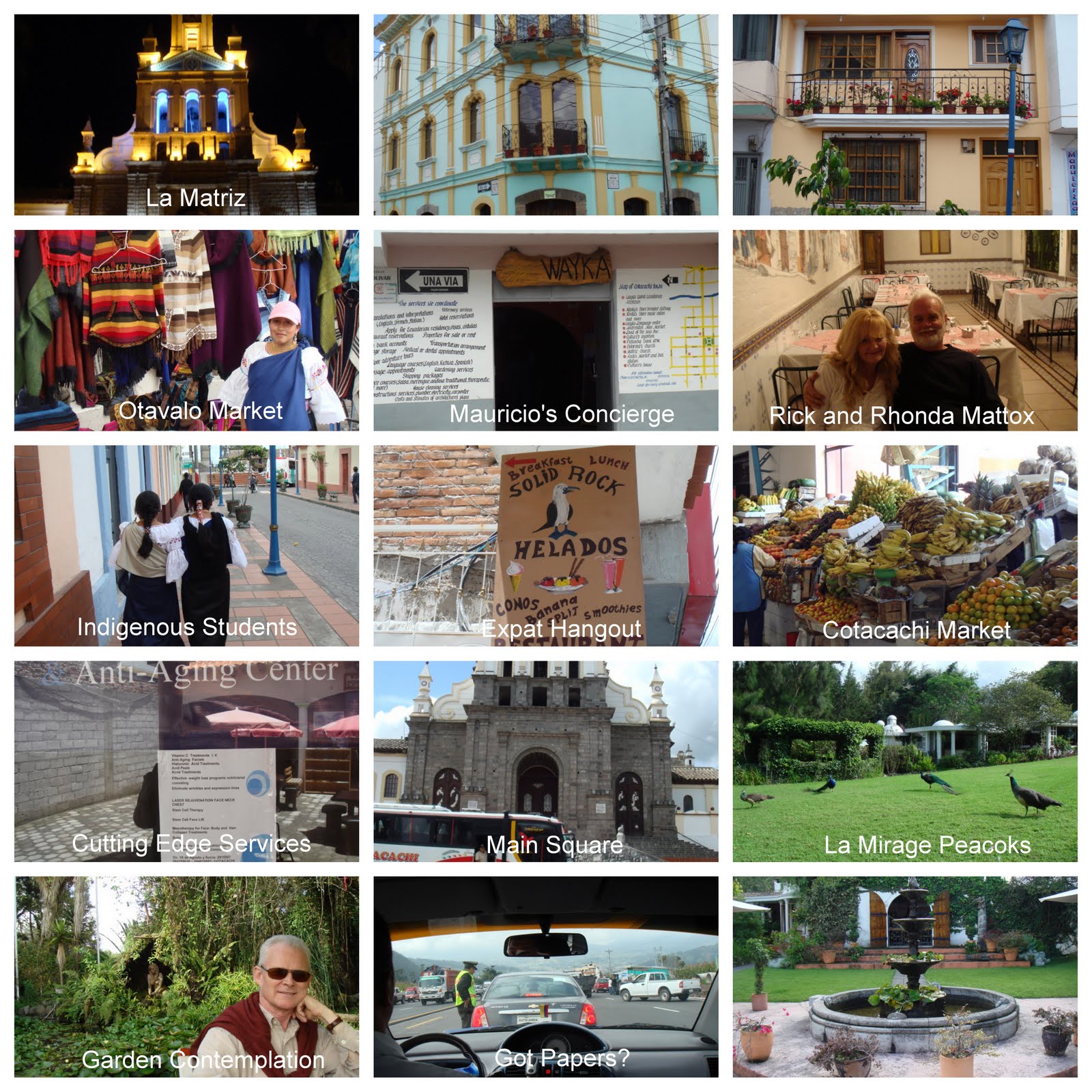
After leaving Quito, we took a 2 hour car ride to Cotacachi. This is a small town nestled in between two beautiful mountains. The town enjoys a pretty main square, plenty of dining options, in and out of town living and not much else.

Prices dropped dramatically,about half, from Quito. Lunch was now $3.50 and dinner $5-6. Wine is expensive - as much as an entree. Our room rate dropped considerably as well.

We stayed at the Land Of The Sun Inn, US phone 336.792.4767. Besides ourselves, the hotel was full with guests attending the Morya Ecuador Discovery real estate tours. Among them were the Mattoxes, who we made fast friends with. Rhonda is a hairdresser and Rick is a character, both an absolute delight from AL.

The hotel itself was comfortable and the staff impeccable. Our room was in no way as roomy as depicted (rooms definitely vary) and anything happening in the hotel was heard. They provided room heaters since Ecuadorians do not typically have temperature control in their buildings. Oh, and the church only rings the bells about 40 or 50 times (Rick says 100) each morning, sometimes as early at 5:45 am! We would return here in a heart beat.

Our new friend, Rhonda, didn't care so much for the food. I can empathize - Ecuadorian food is somewhat bland and often served with multiple starches such as rice, potatoes and plantains. They do serve a type of salsa (salsa di aji) that adds spice and flavor. The "locro" was consistently tasty. We appreciated the reasonable portions. During this trip, Doug and I ate our own entrees for the first time in years.

Along with La Turista, we also dined at the Inn ( lunch and dinner, with more than our fair share of coffee breaks), Serendipity (expat owned), Solid Rock (fabulous tacos), La Mirage (cocktails in the garden) and El Lenador (great meat!). We were pleased with all our dishes. You won't find better tasting avocados. We regret not getting to D'Anitas or Bocaditas.

We spent one day touring with the agent for Adobe Made. Despite the quality product of Adobe Made, we found the San Miguel development most to our liking. Within the development, we were lucky to tour one on the homes featured on House Hunters International. It was a stunner and we wouldn't mind having our own abode in the neighborhood. Our agent, Carolina Denapoli, was a pleasure to work with...cdepoli@gmail.com .

We were having computer problems since we had arrived in Ecuador. Mauricio, a former Land Of The Sun employee, was able to arrange for it to be fixed on a Sunday for $10. gbsmaury@hotmail.com.

Cotacachi was exactly as depicted: clean, safe, affordable and walkable. Housing developed for expats have all the features of home with prices on the high end (likely too pricey for Ecuadorians). We would be interested in touring in town residences to see how the real estate market compares. Besides Carolina, Lee and Peggy Carper are a great resource for rentals, home purchases and real estate investments (a message can be left for them at the Inn). The expat community appears to be close knit. Cotacachi is a short bus ride away from Otavalo and Ibarra, where you will have to go for any kind of shopping, recreation and night life.

Cotacachi convinced us that a life in South America was possible. Practically anyone with a pension or Social Security could live comfortably there. The air is pure, the streets are clean, the people are friendly, the surroundings are spectacular and the atmosphere is peaceful. Now, on to Cuenca.

Friday, March 4, 2011

Quito, Ecuador

Quito, the capital of Ecuador, was the locale for the International Living Ultimate Event. The conference was very productive in our consideration of an expat lifestyle and international investing. Best of all, we met some incredible people whom we hope to enjoy lasting friendship.

Highlights of Quito

Locro de Papa - a potato cheese soup that is ubiquitous in Ecuador.
Azuca Latin Bistro - Plaza Foch, Latin flavors and good cocktails.
Le Ingelsia de la Compania de Jesus - Church in historic Quito. 7 tons of gold leaf decorate this Baroque church of the Jesuits.
Plaza de La Indepencia - Central square where Socialist President Correa addresses the public on Fridays.
Quicentro - Modern and upscale mall in Quito. The food in the court is restaurant quality. They have a restaurant named Menestras del Negro. This popular national chain is named after the enterprising founder nicknamed "del negro" by his family because he is so dark and "Menestras" for the beans meal that is the main dish, his creation. So Mr. Obama and the left can relax - Ecuadorians aren't racist and there is not an outbreak of TEA partiers!
Coffee Tree - We visited the Plaza Foch location. This cafe chain serves authentic espresso drinks.
Magic Bean - Serving Ecuadorian and American meals in the La Mariscal district.
Madonna Statue - The Virgin of Quito is winged and watches over the city from high on a hilltop.
Gianduja Chocolate - Visited this chocolate maker early in the trip. Almost none of the chocolate treats made it home!

Throwing toilet paper in the trash takes getting used to. Just because you see barred windows doesn't mean its dangerous. You likely need an umbrella every day. You can get a meal consisting of a soup, entree and dessert for $10 - and that's considered expensive.